
 The lecture encyclopedia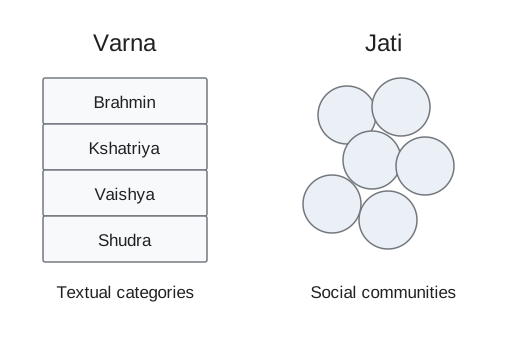
Dharma is responsibility understood in relation to a person's circumstances and place in a larger order. The Laws of Manu organizes these responsibilities through social class, gender, ritual eligibility, and appropriate timing. Its prescriptions are influential and contested, and must be distinguished from a neutral description of how everyone actually lived.
Authority and systematic teaching #
Manusmṛti belongs to smṛti, remembered and human-authored authoritative tradition. It differs in classification from śruti, the heard or revealed authority associated with Vedic knowledge. Calling a text human-authored does not imply that its community regards it as unimportant.
A śāstra is a systematic treatise. Dharma śāstra organizes inherited claims about proper conduct. This systematic format can clarify expectations, but the existence of a rule does not settle every conflict that arises in practice.
Manu's elevated account of learned Brahmins also reveals its perspective. A text defending priestly authority can simultaneously express sincere concern about preserving knowledge and an interest in securing status.
Varna and ritual access #
The four-varna model connects Brahmins with learning and priestly mediation, Kshatriyas with rule and protection, Vaishyas with productive and commercial activities, and Shudras with service. These categories concern ritual eligibility and inherited identity as well as work.[1]
The upper three categories are described as twice-born, referring to initiation and a second, ritual birth. The term does not mean that an individual literally receives another body at initiation. Nor does changing jobs automatically change ritual status in the prescribed system.
Although every category has duties, the burdens and benefits are unequal. A rule commanding service without resentment reveals what its author wants. It cannot establish that people accepted the arrangement without resistance.
Jati and lived complexity #
Jati refers to more specific inherited communities and lineages, often associated with region, language, marriage, and ritual practice. Thousands of such identities complicate any attempt to reduce society to four boxes. The English word caste can obscure this distinction by referring to either varna or jati.
Ritual standing does not map directly onto income or employment. A person with Brahmin identity might work as a cook, while a specialist responsible for a particular life-cycle rite might earn most income elsewhere. A broad status category, an inherited ritual role, and a paid occupation are related but distinct.
Marriage, food preparation, and contact can become significant within purity systems. These practices have differed across communities and periods. They should be described as situated arrangements rather than natural or universal measures of human worth.
Responsibility depends on conditions #
Gendered duties, changing states of purity, and auspicious timing add further conditions. Death or mourning may affect ritual eligibility, while an otherwise appropriate rite may require an appropriate time. Even high ritual status is not a permanent exemption from such conditions.
Contingent responsibility means responsibility depends on circumstances. It does not mean that anything is permissible. The difficulty lies in identifying which conditions matter and how to respond when they conflict.
Karma and rebirth extend consequences beyond immediate social effects. Together, these concepts create a moral framework in which action, inherited position, and future existence are connected. Literature makes the framework harder and more interesting by showing characters confronted with incompatible obligations.