
 The lecture encyclopedia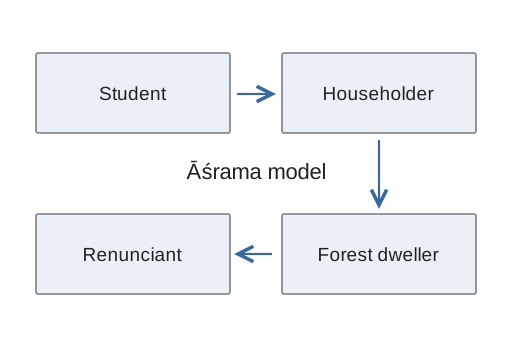
Karma connects action with consequences extending beyond the immediately visible result. Rebirth widens that connection across lives, while moksha names release from continuing existence within the cycle. These ideas create a tension between fulfilling social obligations and seeking freedom from the conditions that continually produce them.
Action and consequence #
Karma includes actions of body, speech, and intention. It need not be understood as a divine judge assigning rewards and punishments. In the framework examined here, consequences belong to a causal moral order.
Ordinary examples illuminate part of the idea. Harmful speech can alter relationships long after it is spoken, and an intention can matter even when it remains hidden. The theory of karma extends beyond such observable effects; the analogy explains causation without reducing the doctrine to social reputation.
Within Manu's system, favorable consequences depend on fulfilling the duties assigned to one's circumstances. Simply taking over another group's ritual activities does not necessarily count as responsible action. Conversely, elevated ritual standing does not protect someone from the consequences of neglected duties.
Rebirth and liberation #
A favorable rebirth is different from liberation. Another advantageous life still involves responsibilities, desires, actions, and future consequences. Moksha concerns release from that continuing cycle.
The theory can support different interpretations. Rebirth allows future change in circumstances, but it can also be used to explain or justify present inequality through past action. Describing this second use is not an endorsement of blaming people for their social position.
Liberation is an important ideal without being every person's immediate practical objective. Everyday responsibilities can remain central even where release is recognized as a profound possibility.
The four life stages #
Manu's life-stage framework offers one response to the tension between society and renunciation. Its normative model chiefly concerns an eligible male subject rather than a universal biography.
The student learns under a teacher and observes disciplines that prepare him for later responsibilities. The householder marries, supports a household, and enables a succeeding generation to continue its obligations. Producing a child alone does not complete this work; the successor must be prepared.
The forest dweller gradually withdraws while potentially retaining family connections, ritual identity, and fire rites. The renouncer relinquishes ordinary social and ritual obligations in pursuit of release. Renunciation is therefore more than simply living among trees, and forest residence does not automatically mean that all social ties have ended.[1]
These distinctions matter in literature, where an ascetic in a hermitage can still have relationships and obligations. Location by itself does not establish a person's life stage.
The problem of leaving #
Delaying withdrawal until household duties are fulfilled protects the continuity of family and ritual life. Stories of urgent renunciation raise a different possibility: the search for awakening may appear too important to postpone.
This is a genuine conflict of priorities. Society relies on people who perform ongoing duties, yet the ideal of liberation questions whether those duties can ever finally be completed.
The Ramayana turns related problems into narrative. A father, ruler, spouse, or son can owe duties to several people at once. The life-stage framework supplies vocabulary for understanding responsibility, while stories test how far that vocabulary resolves difficult choices.