
 The lecture encyclopedia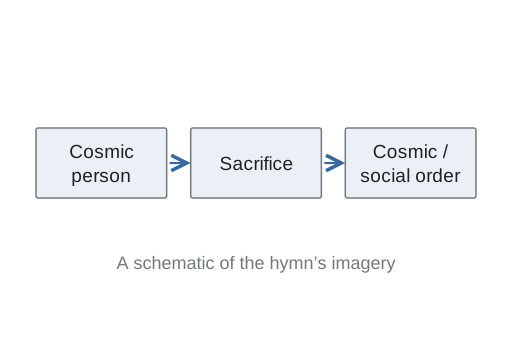
Vedic creation narratives connect the emergence of the world with the responsibilities needed to sustain it. The stories of Prajapati and Purusha explain sacrifice through bodily images, speech, food, and social roles. They also reveal how a text can make a particular arrangement of society appear continuous with the structure of the cosmos.
Prajapati and the danger of creation #
Prajapati creates Agni, but fire needs nourishment. With little available to consume, creation threatens its creator. The problem links cosmic beginnings with an ordinary fact: fire must be fed, yet it can destroy those who depend on it.
Speech also enters the narrative as a creative power. Vāc, the Sanskrit word for speech, is grammatically feminine and is personified accordingly. Fear, utterance, and offering become interdependent parts of the explanation.
The story follows unsuccessful and successful offerings. It relates their material characteristics to plants, bodily features, and cosmic phenomena. Linguistic associations help connect these developments. The result is an account that explains why particular materials and words belong together in ritual.
Knowing and repeating a saving pattern #
Prajapati survives through offering. The person who knows the story and performs the relevant rite participates in that pattern. Knowledge is not merely background information: it helps establish what the action means and why it is effective within the text's worldview.
The account connects continuity through descendants with survival beyond bodily destruction. Fire can consume a corpse while also serving as a means of transformation. These early ideas should not automatically be equated with every later doctrine of reincarnation or liberation.
A productive reading asks what danger the story identifies, what response resolves it, and how a human practitioner is said to repeat that response. This preserves the connection among narrative, ritual action, and promised result.
Purusha and the cosmic body #
The Purusha hymn presents a primordial person whose sacrifice produces the world. Parts of the body correspond to cosmic features, living beings, and social classes. Sacrifice even generates elements needed for sacrifice, creating a circular explanatory structure.
The four varnas emerge through bodily imagery: Brahmins from the mouth, Kshatriyas from the arms, Vaishyas from the thighs, and Shudras from the feet. Speech, rule and protection, production, and service become related functions within a single imagined body.[1]
The image combines interdependence with hierarchy. All parts belong to the whole, but their placement is not socially neutral. A reader should examine both the claim that everyone contributes and the unequal authority assigned to those contributions.
Prescription and social reality #
A cosmic account of four social categories is not a census. It presents an explanation and justification of order, rather than proof that every historical person fit neatly into one of four occupations. Jati, involving more specific inherited community identities, complicates the broad model.
A comparison with work makes the moral issue concrete. Employment depends on networks of obligations, expertise, trust, and exchange. Yet modern assumptions about choosing a career differ from a system that ties responsibilities to birth and inherited position.
These narratives invite a broader question about dharma: does doing one's assigned part secure a good life, and what happens when duty conflicts with happiness? Later narrative literature develops precisely such tensions.