
 The lecture encyclopedia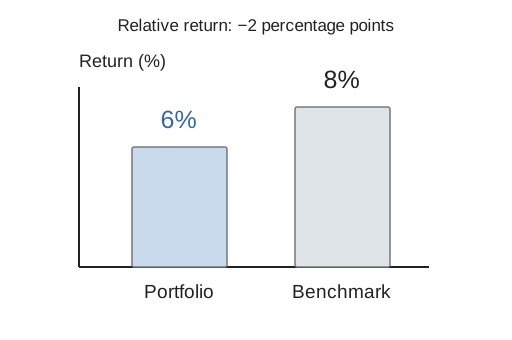
Investment and lending decisions depend on the purpose of the funds, the incentives of decision-makers, and the risks hidden by a favorable central forecast. Portfolio management asks how exposures serve an investor's objectives. Credit analysis asks whether a borrower can repay and what protects the lender when the plan disappoints.[1]
Absolute and relative performance #
A portfolio can earn a positive return while underperforming its benchmark. Managers judged against an index may therefore focus on relative performance rather than simply avoiding losses. Asset-based fees and investor withdrawals can reinforce that incentive.
Closet indexing describes a strategy that remains close to benchmark exposures while presenting some degree of active management. A position can be underweight relative to a benchmark while still being large in absolute terms.
The benchmark should fit the purpose of the money. Retirement assets, venture investments, and a short-term trading strategy can have different horizons, liquidity needs, and tolerance for losses.
Exposure and calculation #
Owning several funds does not automatically create diversification. A broad equity fund may already contain substantial technology exposure, so adding a technology fund can increase concentration through overlapping holdings. Similarly, gold is only one commodity exposure, and international holdings can introduce currency risk.
For a simple fixed-weight example, portfolio return is the sum of each weight multiplied by its corresponding return. If 60 percent earns 10 percent and 40 percent earns 5 percent, the portfolio earns 8 percent before costs. Adding the two returns directly would incorrectly give 15 percent.
Option premiums, fund expenses, and trading costs must also be included. A hedge can reduce a particular downside while lowering returns in a benign scenario.
Risk, uncertainty, and incentives #
Risk analysis often assumes probabilities can be estimated. Uncertainty becomes especially important when available evidence does not support a dependable probability model. Scenarios help identify assumptions without pretending to know exact odds.
An argument may also reflect the speaker's interests. A manager advocating an outcome favorable to existing holdings is sometimes described as talking their book. This prompts scrutiny of evidence and incentives; it does not by itself prove the claim false.
From relationship banking to credit decisions #
A relationship manager seeks business and maintains the borrower relationship. A risk manager examines repayment capacity and downside exposure. A useful credit process allows both perspectives to inform the decision without making risk approval merely another sales target.
Expansion projects carry different risks. Increasing capacity for established demand differs from entering a new geographic market or launching a new product. Experience in one area does not establish success in another.
Conditions and covenants #
Loan conditions can require equity funding to close before debt is drawn. Covenants can limit distributions, additional borrowing, or other actions that weaken repayment capacity. Reporting and financial tests help detect deterioration.
Collateral is a secondary source of recovery, not a substitute for viable cash flow. Its liquidation value can differ substantially from book value. A guarantee is another distinct source of support and must be assessed on its own merits.[2]
A defensible decision connects every condition to a specific risk. The objective is a loan the borrower can repay, rather than an impressive list of restrictions that fails to address the business problem.