
 The lecture encyclopedia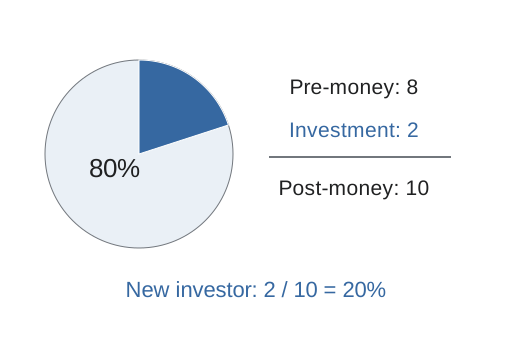
Startup financing connects the resources needed to develop a business with the ownership, control, and financial rights investors receive. For a hardware startup, a working proof of concept is only one milestone. Manufacturing design, tooling, testing, component sourcing, and repeated revisions can require substantial capital before dependable sales begin.
Match funding to development #
A financing plan should distinguish a demonstration from a product that can be manufactured and delivered consistently. Early production costs may be high because fixed setup costs are spread across few units. Larger scale can reduce unit costs, but only after technical and operational problems are resolved.
Staged funding links additional capital to milestones. This can reduce the amount committed before uncertainty is resolved, while also exposing the startup to the risk that another round is unavailable when needed.
The relevant question is not simply how much cash exists today, but what must be achieved before it is exhausted.
Sources of capital #
Friends-and-family funding can rely on personal trust, but it does not eliminate business risk or the possibility of loss. Crowdfunding can test public interest and help finance development, while a visible failure to meet a target can affect later fundraising.
Different crowdfunding arrangements create different commitments. A campaign promising a product is not equivalent to selling equity. Demand expressed through a campaign also does not prove that manufacturing and delivery will succeed.[1]
Bank loans require a credible repayment case. A business with little revenue and negative operating cash flow may struggle to support ordinary debt payments. Equity investors instead share in uncertain future upside and accept the possibility that their investment is lost.[2]
Angel investors generally invest their own capital. Venture funds deploy pooled capital through an investment process. Both can provide expertise and connections in addition to money, but their involvement may bring governance expectations and pressure for an eventual exit.
Valuation and dilution #
Valuation determines how a new investment translates into ownership. In a simplified financing, an investment of 2 into a business valued at 8 before the investment produces a post-investment value of 10 and a 20 percent stake for the new investor. This arithmetic assumes a straightforward structure without other instruments or adjustments.
Later rounds can dilute earlier ownership percentages. A smaller share of a much more valuable business can still be worth more, so percentage ownership and economic value are different questions.
The headline valuation is only part of the bargain. Special rights can make two investments at the same apparent valuation economically different.
Preferred stock and investor protection #
Convertible preferred stock combines preferred rights with an ability to convert into common equity under specified terms. Liquidation preferences affect the order in which proceeds are distributed. Participation rights can affect whether an investor receives both a preference and a share of remaining proceeds.
Dividend provisions and anti-dilution terms can further change outcomes. These are contractual mechanisms whose effects depend on the exact language; their names alone do not establish a universal payout.
A useful analysis compares outcomes under low, moderate, and high exit values. Terms designed for downside protection can shift a large share of proceeds away from founders or other shareholders in some scenarios.
Capital and control #
Funding decisions therefore involve more than choosing the largest cheque. Founders must consider resources, expertise, dilution, decision rights, and the path to later financing or public-market readiness. Investors assess whether the business can progress through milestones that justify committing further capital.