
 The lecture encyclopedia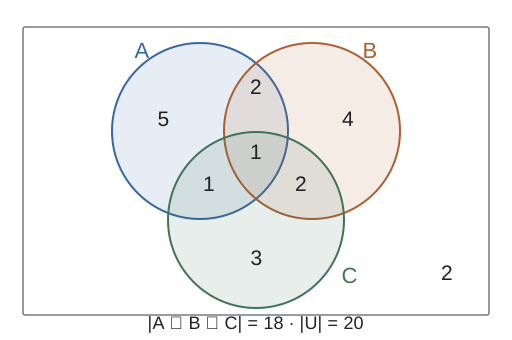
Three-set counting turns overlapping category totals into disjoint regions. A problem may ask for a region directly or supply enough totals to infer a missing intersection. The same membership logic supports both directions.
Translate the wording #
“At least one” means the union. “None” means its complement within the universe. “Exactly one” includes the three only regions. “Exactly two” includes the three pairwise-only regions and excludes the triple intersection. “At least two” adds the triple region to the exactly-two total.
These phrases cannot be interchanged. A member of all three sets contributes once to the union, three times to a sum of individual set sizes, and three times to a sum of inclusive pairwise intersections.
A complete teaching example #
Let a universe contain 60 objects. Suppose the set totals are |A| = 25, |B| = 24, and |C| = 20, with inclusive pairwise intersections 10, 8, and 7 and triple intersection 4.
The exactly-two regions are 6 for A and B, 4 for A and C, and 3 for B and C. The only regions are 11 for A, 11 for B, and 9 for C. The union is 11 + 11 + 9 + 6 + 4 + 3 + 4 = 48, leaving 12 outside all three sets.
Exactly one therefore totals 31, exactly two totals 13, and at least two totals 17. Reconstructing each circle's total verifies the diagram.
Solving backward #
If the universe and the outside count are given, subtract to obtain the union. Inclusion-exclusion can then solve for an unknown intersection. Write an equation before substituting numbers so the sign of the unknown is clear. An inclusive pairwise count still contains the triple count even when it is the quantity being solved for.[1]
Consistency #
A pairwise intersection cannot exceed either containing set, and an exclusive region cannot be negative. Contradictory totals should be reported as inconsistent rather than forced into a plausible picture.