
 The lecture encyclopedia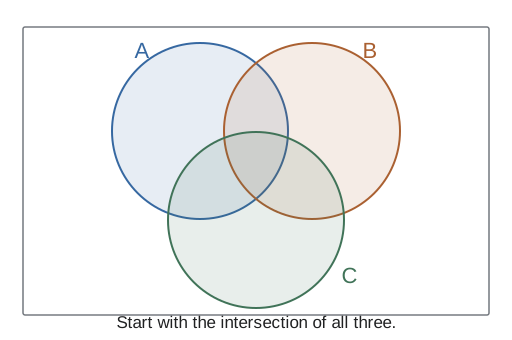
A Venn diagram divides a universe into regions according to set membership. For counting problems, each region must represent a mutually exclusive category. For shading problems, membership conditions determine which regions belong to an expression.
Region-by-region reasoning #
With two sets A and B, the universe splits into A only, B only, both, and neither. To shade A ∪ B′, include every region in A and every region outside B. The only excluded region is B only. This direct membership test is more reliable than guessing from the overall appearance of a diagram.[1]
With three sets, each point can be in or out of each set, giving eight possible membership combinations. An expression such as (A ∩ B′) ∪ C includes every region of C as well as points in A but not B.
Totals and exclusive counts #
A statement that 30 respondents belong to A usually includes respondents who also belong to B. If 12 belong to both, A only has 18. The word “only” changes the quantity. Likewise, “or” in a set union is inclusive unless the problem explicitly specifies exactly one of the categories.
Work from the center outward #
For a three-set survey, first place the triple overlap. Subtract it from each inclusive pairwise intersection to obtain the exactly-two regions. Then subtract all appropriate overlap regions from each set's total to obtain its only region.
Suppose A, B, and C have totals 20, 18, and 15; pairwise intersections are 8, 6, and 5; and the triple intersection is 3. Exactly A-and-B is 5, A-and-C is 3, and B-and-C is 2. The only counts are 9, 8, and 7. Adding all seven inside regions gives 37.
Outside the circles #
If the universe has 50 members in that example, 13 belong to none of the three sets. The universe total is essential for calculating “neither” or “none”; it cannot be recovered from the circle totals alone.
Checking a result #
Every region count should be nonnegative. The regions of each circle must sum to its stated total, and all eight regions must sum to the universe. Failure of one of these checks usually indicates that an inclusive intersection was treated as exclusive or that a total was counted twice.