
 The lecture encyclopedia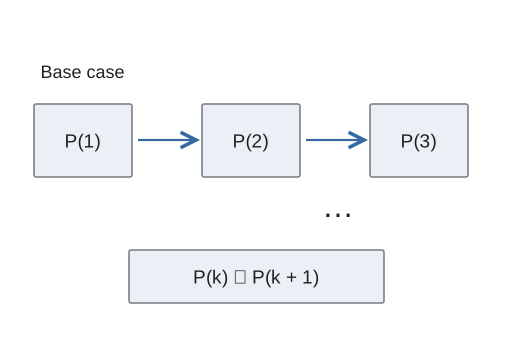
A sequence is an ordered list of terms indexed by position. A summation adds selected terms. Mathematical induction proves a statement across an integer range by establishing a starting case and a rule that carries truth to the next case.
Arithmetic and geometric sequences #
An arithmetic sequence adds a constant difference. With first term a₁ and difference d, its nth term is aₙ = a₁ + (n - 1)d. For first term 3 and difference 4, the first terms are 3, 7, 11, and 15.
A geometric sequence multiplies by a constant ratio. Its nth term is aₙ = a₁rⁿ⁻¹. With first term 2 and ratio 3, the terms begin 2, 6, 18, and 54. An explicit formula computes a term directly; a recursive definition gives a starting value and a rule using earlier terms.
Sigma notation #
Σᵢ₌₁ⁿ aᵢ means add terms beginning at index 1 and ending at index n. The index is a local counting variable; the limits determine which values it takes. For example, Σᵢ₌₁⁴ (2i + 1) expands to 3 + 5 + 7 + 9 = 24.
A finite arithmetic sum equals the number of terms times the average of the first and last terms. Thus 1 + 2 + ... + n = n(n + 1)/2. Carefully count the included terms when the lower limit is not one.
The induction structure #
To prove that sum formula for all positive integers, verify n = 1: both sides equal 1. Then assume the formula holds for an arbitrary positive integer k. Adding the next term gives:
1 + ... + k + (k + 1) = k(k + 1)/2 + (k + 1)
Factoring yields (k + 1)(k + 2)/2, exactly the required formula at k + 1. The base case starts the chain; the implication connects successive cases.
Why examples are insufficient #
Checking several numbers can suggest a pattern but does not prove an infinite claim. The inductive hypothesis is a temporary assumption inside the implication, not an assumption that the final theorem is already true. Both a valid starting case and a valid inductive step are necessary.[1]
Set notation and counting remain useful background: identify the domain of the index and state precisely which values the proposition covers.