
 The lecture encyclopedia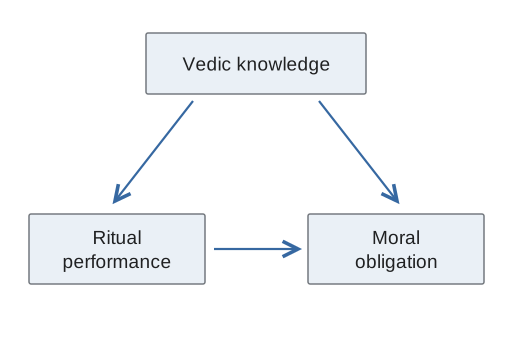
Vedic ritual connects knowledge with responsibility. Maintaining a fire, preserving a hymn, or preparing an altar can be understood as an obligation to a wider community of living people, ancestors, and divine beings. This approach makes practice and relationships central to the study of religion, alongside beliefs and doctrines.
A diverse religious world #
Hindu traditions encompass many languages, regional practices, deities, philosophical positions, and forms of social organization. No single definition based on a founder, book, or uniform creed captures that diversity. The term Hindu developed from a geographical designation associated with the Indus region. Its later religious use does not mean that the traditions grouped under it began at the same moment.
Sacred geography is significant, but a religion cannot be reduced to national boundaries. South Asian traditions have developed through interaction and debate, and Hindu communities also exist outside South Asia. Describing this diversity requires attention to particular communities and texts rather than assuming that every practice represents everyone.
Veda and the authority of sound #
Veda means knowledge. The earliest Vedic hymns are associated with ritual recitation by trained specialists. Their authority is traditionally understood through śruti, meaning what is heard: revelation received by seers, or rishis. Smṛti, what is remembered, describes another category of authoritative inherited tradition.
Historical accounts of the transmission and development of a text differ from theological accounts of its eternal authority. A traditional understanding of Vedic sound as eternal does not function as a modern historical date. These are different kinds of claim about the same material.
Exact sound has a role that paraphrase cannot simply replace. In the ritual framework, knowing a hymn includes knowing how and when to recite it. Memorization and patterned repetition therefore preserve more than general meaning. They transmit an authorized performance across generations.
Fire as a relationship #
Agni is fire understood as a divine presence. Fire consumes offerings and mediates communication with divine recipients. The sponsor provides resources, while priests perform specialized tasks. The sponsor and priest need not be the same person.[1]
A sacrifice requires coordination: fire, offerings, an altar, correct recitation, and trained participants must come together. Preserving a fire also requires ordinary physical care. Religious responsibility thus involves material work as well as interpretation.
Altar construction connects ritual practice with measurement, geometry, materials, and engineering. Attention to these practical requirements helps explain why ritual knowledge can become an extensive intellectual tradition. It does not imply that all later scientific discoveries were already present in ancient texts.
Exchange and obligation #
Sacrifice can be interpreted through reciprocal exchange. Offerings and praise are given in pursuit of benefits such as health, prosperity, descendants, and a favorable existence beyond death. The exchange depends on a network of obligations rather than a single isolated act.
A useful comparison is an ordinary contract. A promise of payment depends on trust, institutions, and the ability of others to perform their roles. The comparison makes interdependence visible without claiming that ritual is identical to commercial exchange.
Dharma, broadly associated here with responsibility and sustaining order, becomes a way to investigate these relationships. The central interpretive question is who owes what to whom, and why a seemingly small action can matter to a much larger world.