
 The lecture encyclopedia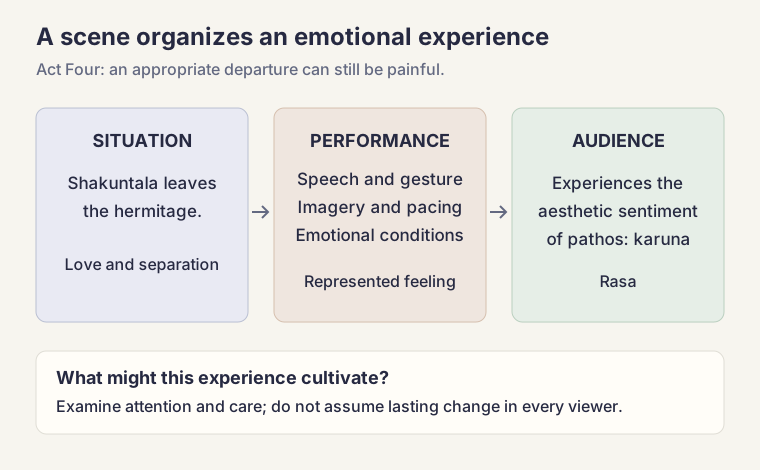
Can a story change how an audience cares about other people? Kalidasa's Shakuntala provides a way to examine that question through love, separation, recognition, and reunion. The review connects dharma with dramatic feeling, then introduces the funeral dispute in Samskara as a preview of a later literary problem.
Read Shakuntala's structure and rasa for the preceding close reading. Here the central question is how a deliberately constructed world might develop an audience's emotional attention. The proposed moral effect remains a claim to examine, rather than an automatic result of watching a story.
Explain a conflict through particular responsibilities #
Dharma concerns sustaining order and fulfilling responsibilities in context. A useful analysis identifies who must act, whom they owe something to, and which expectations collide. Calling a character responsible does little unless the relevant responsibility is made concrete.
Shakuntala's absorption in love leads her to overlook a visiting ascetic, provoking the curse. Dushyanta's grief also interrupts his public responsibilities. Desire and duty obstruct each other before the play's final family recognition brings them into a restored order.[1]
Compare that resolution with the difficult outcomes in the Ramayana. Ask how each work makes obligations felt through a scene: a king's responsibility toward the kingdom, a spouse's relationship, or the vulnerability of a person whose standing others question. Contingent dharma draws attention to circumstances and relationships. It does not mean that every preference becomes a duty or that a conflict disappears as soon as someone names it.
Separate depicted emotion from the audience's experience #
An actor represents a character's emotional situation. The audience experiences the organized performance. Rasa, often discussed through the metaphor of tasting, concerns this experienced aesthetic feeling.
For a closer reading, distinguish several parts of the emotional construction. The Nāṭyaśāstra connects rasa with circumstances that evoke feeling, expressive signs, and accompanying psychological states. A durable emotional disposition supplies the basis for a particular sentiment.[2]
| Term or relationship | What to notice |
|---|---|
| Bhava | An emotional state represented or developed in performance |
| Vibhava | People, situations, or surroundings that evoke feeling |
| Anubhava | Expressive signs such as speech, gesture, and visible response |
| Sthayibhava | A durable emotional disposition around which the experience develops |
| Rasa | The audience's aesthetic experience of the organized emotion |
The review focuses on three relationships: rati, attraction or love, supports shringara; shoka, sorrow, supports karuna; and utsaha, energetic resolve, supports vira. Translations vary: karuna can be described through pathos and compassion, while vira is the heroic sentiment. Keep the portrayed emotional basis and the resulting aesthetic experience distinguishable.
Spring imagery, a setting, a pause, an actor's movement, or the rhythm of a departure can help construct that experience. A modern film can organize attention through music, framing, lighting, and editing. List these choices before claiming that a work simply contains a sad or romantic mood.
Work through Act Four's departure #
Shakuntala leaves the hermitage for her marriage. The departure can be appropriate and still painful: belonging to a new household also means separation from the family and environment that cared for her.
Begin a close reading with the event. Next identify the bonds made visible through the farewell, the language and actions that communicate grief, and the feeling invited in the audience. The emotional movement is richer than a verdict that the marriage is good or bad. Affection, hope, and loss coexist.
An original comparison is a story in which a child leaves home for a long-awaited opportunity. The family may support the decision while feeling its cost. That comparison clarifies the tension; it does not establish that the two works have identical social assumptions. Return to the particular scene and explain which details make the comparison useful.
Ask what artifice makes possible #
Shakuntala's prologue openly introduces a performance. Its idealized hermitages, repeated scenes, and eventual reconciliation organize an emotional journey. Knowing that a world has been constructed does not prevent an audience from responding to it.
The ethical argument examined here is that such an experience can cultivate capacities for concern, love, courage, or perseverance. Its effect may be broader than a rule to copy a fictional hero's action. A viewer can practice attending to another person's vulnerability and carry that attention into situations the story never depicted.
There are reasons to question the argument. A viewer may be distracted, misunderstand the scene, or enjoy it without any lasting change. Emotional attachment can also become confused or hostile. A careful response distinguishes the work's intended emotional design, a viewer's actual experience, and any later conduct. Evidence for one does not settle the others.
Understand the memory and rebirth explanation #
The play links an apparently unexplained feeling with traces of a love the king cannot presently recall. Act Five describes how a beautiful sight or song can stir longing without an accessible memory of its cause. The dramatic explanation invokes attachments from an earlier life.[1]
This supplies a religious and aesthetic account of why art can awaken a feeling that seems already available within us. A contemporary analogy is being unexpectedly moved by music before identifying a memory. Use the analogy to make the question intelligible; keep it distinct from a claim that the analogy proves rebirth or reproduces the whole theory.
Preview Samskara's funeral dispute #
U. R. Ananthamurthy's Kannada novel opens with the death of Naranappa, a Brahmin whose conduct challenged the community's ritual and purity expectations. The others turn to the respected scholar Praneshacharya for guidance about the rites, but he cannot resolve the urgent dilemma. This is an introductory preview, rather than a complete interpretation of the novel.[3]
Performing the rites raises questions about purity and reputation; refusing them leaves a member's death unresolved. The dispute combines inherited categories with an immediate practical need. Ritual standing also affects the community's livelihood, complicating any claim that the decision is purely abstract.
The introduced characters offer different positions. Praneshacharya searches authoritative texts while carrying responsibilities of care. Naranappa has exposed tensions in the group's ideals. Chandri's effort to secure the rites directs attention toward action, attachment, and the limits of the community's judgment. Treat caste and purity judgments as contested standards within the novel, and ask how the narrative tests them.
The term samskara connects the crisis with life rites and transitions. This creates a bridge to earlier discussions of social roles, stages of life, karma, and responsibility. The guiding question is whether inherited texts and categories can resolve the demands of a changing situation. Preserve that question while reading; a plot summary alone cannot answer it.
Practice with explained answers #
Why can Act Four invite grief when the family supports the marriage? An appropriate transition can still separate people who care about each other. Explain the competing feelings through details of the farewell.
Is rasa simply whatever emotion an actor privately feels? No. Rasa concerns the audience's aesthetic experience of a structured representation. Acting helps create it, but the performer and audience occupy different roles.
How would you examine whether a familiar film develops moral attention? Choose one scene, identify its formal choices, explain the feeling they invite, and propose a capacity that feeling might cultivate. Then consider another plausible response and the limits of evidence for lasting change.
Why does the opening of Samskara challenge a simple definition of duty? The community faces competing concerns about rites, membership, purity, care, and reputation. A developed answer identifies the people, obligations, and practical stakes before evaluating a response.