
 The lecture encyclopedia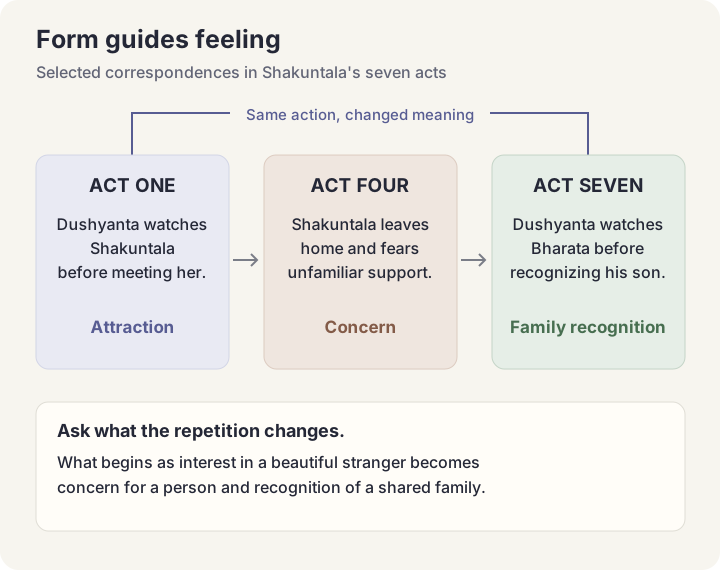
The Recognition of Shakuntala asks how a love story can educate an audience's feelings. Kalidasa organizes desire, separation, grief, courage, and reunion so that we become concerned for the characters' lives. The play's emotional force depends on its form: poetic language, performance, repeated situations, and the timing of what the audience knows.[1]
Dharma here means responsibility within a sustaining moral and social order. Rasa means aesthetic taste or savor: the experience of feeling made available through art. The central question is how a carefully arranged fiction can lead us from admiring beauty to caring about another person's welfare. This continues Lecture 11's account of love and dharma, with closer attention to dramatic structure and the audience's experience.
Begin with the people and the problem #
Shakuntala has grown up in the forest hermitage of Kanva, her adoptive father and a religious sage. A hermitage is a community devoted to religious discipline; this one also contains family relationships, friendship, and care for plants and animals. Dushyanta is a king whose responsibilities include protecting such communities and administering justice.
The two fall in love and privately marry. Their union still needs recognition within the wider family and royal world. While absorbed in thoughts of Dushyanta, Shakuntala fails to welcome the ascetic Durvasas. His curse causes the king to forget her; the sight of a token he gave her can restore his memory. She loses the ring, so he does not recognize her when she arrives at court. Its eventual recovery restores memory, but cannot immediately repair their separation.
Keep the difference between the audience's knowledge and the king's knowledge in view. We can understand the curse and know that Shakuntala tells the truth while watching him act without that understanding. His uncertainty belongs to the plot; our concern for the person harmed belongs to its emotional effect.
Two directions of conflict: duty and love #
Dharma obstructs love when obligations delay what the lovers want. Kanva's absence delays familial approval and the proper departure from his household. Palace expectations pull Dushyanta away from the hermitage. Protecting the religious community gives him a legitimate reason to remain there, even while he wishes to be near Shakuntala.
Love obstructs dharma when attachment absorbs attention needed elsewhere. Shakuntala's romantic distraction interferes with hospitality. After the ring restores his memory, Dushyanta's grief interferes with governance. These are paired situations: she cannot attend to a guest; he cannot attend normally to those who depend on his office.
At court, Dushyanta explains his refusal partly through the duty to avoid another man's wife. Within the curse plot, he lacks the memory that would resolve his doubt. That explanation does not erase Shakuntala's distress or make every reader accept his treatment of her. A careful interpretation holds together the play's effort to preserve an exemplary king and the unequal burden placed on the woman who seeks recognition.
Religious figures also differ from one another. The king's comic companion and Durvasas's anger do not make the play a blanket attack on Brahmins, members of the priestly social category. Kanva and the final divine sage offer respected religious authority. The contrast concerns how particular figures carry out their roles, even while kingship receives a reassuring portrayal.
The comparison with the Ramayana is useful. The epic repeatedly makes duties collide with painful consequences. This play moves toward an ideal reconciliation of family, religious authority, and royal responsibility. That is a difference in literary emphasis, rather than proof that all epic narratives are tragic or every drama presents a simple moral world.
Reading the spring festival as public grief #
In Act Six, young women prepare to offer a mango blossom to the god of love. Spring, flowering, romance, and worship are connected in the scene. A chamberlain interrupts: the grieving king has prohibited the spring festival. The surrounding imagery depicts nature itself as unable to complete its expected seasonal activity.[1]
Follow the scene through three questions. First, what would normally happen? The season would prompt celebration and an offering. Second, what stops it? The king's sorrow becomes a command affecting others. Third, why does that matter beyond the palace garden? His emotional impairment extends to justice and public duties; he asks the minister to send written decisions because a sleepless night has left him unable to sit in judgment.
The comic companion's joke about the king's recurring Shakuntala sickness makes the impairment visible without making the underlying grief disappear. Humor and sorrow can coexist in one scene.
The passage therefore gives private feeling a public scale. It is a dramatic representation of relationships among kingship, ritual, nature, and community. It should not be treated as a literal survey of what every historical person believed about flowers obeying a ruler's emotions.
An artificial stage invites a real response #
The prologue openly introduces the theatrical production. Rather than hiding the performers, it makes their work part of the audience's entry into the story. A spectator can know that a play is being performed and still willingly participate in its imagined world.
The opening hermitage description shows how that participation works. Listen for trusting deer, traces of offerings, and wet bark garments. These details do not describe a wilderness free from people. They present people, religious practice, and the natural world as fitting harmoniously together.
A small stage need not contain a complete forest. Poetry, movement, costume, and gesture can suggest it; the audience completes the image. The experience is therefore shaped by both the performance and the perceiver's imagination.
Sanskrit drama also combines dialogue with formal poetic verses and differences of language and register. A register is a manner of speaking associated with a situation or social position. Translation may convey the placement and imagery of a verse while changing its sound and linguistic associations. Read a poetic passage as an event in the scene: why does this speaker turn to this image at this moment?
The accessible translation cited below supplies a text for comparing these scenes. Wording and textual details can differ across editions. Identify a passage by its act and dramatic situation rather than assuming identical phrasing or page numbers.
Seven acts, repeated situations, changed meanings #
The play's seven acts support several correspondences. The earthly hermitage has a divine counterpart. Kanva's role as a religious guardian is echoed by the divine sage; Gautami and Aditi occupy related places in their communities. The earthly charioteer has a counterpart in Matali, the charioteer of the divine king Indra. The parallel settings give royal and religious roles a place at more than one level of the imagined world.
The most revealing repetition occurs between Act One and Act Seven. Early in the play, Dushyanta watches Shakuntala from concealment and becomes curious about her. Near the end, he watches the child Bharata before recognizing him as his son. The physical action of watching is repeated, but its meaning develops from romantic discovery toward family recognition.
Another correspondence links Shakuntala's distraction in love with Dushyanta's later grief. Their social roles differ, but both lose the ability to attend fully to a responsibility. A repeated situation invites comparison without making the two experiences identical.
Structure matters because it changes our response. Counting matched scenes is only a beginning. Ask what the later scene makes us remember and how that memory transforms the present encounter. Act Four stands at the center of the seven-act sequence, where the apparently promising marriage becomes an emotionally difficult departure.
Close reading: the vine leaving its support #
In Act Four, Shakuntala leaves the household where she has grown up to join her husband's household. Marriage can be welcome while leaving home remains painful. Kanva's advice about elders, co-wives, patience, servants, and humility locates this transition within gendered expectations about a wife's conduct.[1]
The scene can be read in four steps.
- Identify the immediate tension. Shakuntala wants to see her husband, yet hesitates to leave the people and place she knows. These desires coexist; her sadness does not mean the marriage is unwanted.
- Follow the image. She compares separation from her father to a vine being stripped from its supporting tree. A vine's attachment makes support visible. Removal suggests vulnerability and the difficulty of living in unfamiliar surroundings.
- Connect image and social expectation. The scene assumes that a daughter will enter another household. The vine makes that prescribed transition feel bodily and frightening. It does not establish that every woman is naturally dependent or that the prescription should be accepted today.
- Add the audience's knowledge. We know about the curse and the threatened failure of recognition. Her uncertainty is already moving, but the prospect of rejection gives it another layer: the new support she expects may not be available.
The advice and the tears do different work. Advice names the conduct expected of her; tears show what fulfilling that expectation costs. The scene brings dharma and lived feeling together rather than imagining that dutiful people become emotionless.
A critical reading can recognize the scene's care while questioning its hierarchy. Kanva's concern for her is real within the fiction, but advice to tolerate a husband's harshness places a burden on the wife. Emotional appreciation does not require suspending judgment about that burden.
Bhava and rasa: distinguish the cue from its savor #
A bhava is an emotional state or condition represented in performance. Rasa is the aesthetic savoring of an organized emotional experience. A character's sorrow, an actor's gesture, and an audience member's compassionate response are related, but they are not simply the same event.
The classical Nāṭyaśāstra, a treatise on dramatic performance attributed to Bharata, uses a food analogy. Ingredients gain a distinctive taste through their arrangement; likewise, situations, expressions, and accompanying states work together in dramatic feeling. It distinguishes underlying emotional states from corresponding rasas.[2]
| Underlying state | Corresponding rasa | Plain-language guide |
|---|---|---|
| Rati: love or attraction | Shringara (śṛṅgāra): erotic or romantic savor | Experiencing love through a shaped artistic situation |
| Sorrow | Karuna (karuṇa): pathetic or compassionate savor | Concern for suffering made available through the scene |
| Utsaha (utsāha): energy or resolve | Vira (vīra): heroic savor | A felt appreciation of courage and purposeful action |
Rati is not the name of the romantic rasa, and utsaha is not the name of the heroic rasa. Keeping the two columns separate prevents that common confusion. The treatise lists eight rasas; later discussions also develop a ninth, associated with peace. This lecture concentrates on the three above rather than attempting the entire classification.[2]
This is a selective introduction to a long interpretive tradition. It does not establish exactly which later theoretical formulations Kalidasa knew when composing the play.
From attraction to concern, then to hope #
In the early hermitage scenes, flowers, vines, the season, costume, and poetic description invite attraction and curiosity. Shakuntala initially appears through a beautiful environment and the king's admiring attention. But an attractive introduction alone gives the audience little reason to care what happens next.
Her departure and rejection add vulnerability. We begin to attend to her welfare: where can she go, who acknowledges her, and what support can she rely on? Compassion changes the significance of the character. She becomes someone whose suffering matters, beyond the pleasure of looking at an appealing figure.
Later, Shakuntala's dignity and care for her child offer reasons for hope. Dushyanta's service to Indra restores purposeful royal action after debilitating grief. This lecture reads those developments through the energy associated with heroism, while recognizing that care and endurance can also make courage visible.
Bharata, their son, brings the family into the final recognition. He is a different figure from Rama's brother of the same name. In the ending, royal power and religious authority become complementary, and the child gives that reconciliation a future. A courtly audience could find reassurance in such an ideal image of kingship. That possibility is an interpretation of the play's values; it does not establish a precise patron or turn the fictional harmony into a description of actual society.
The emotional sequence helps explain why reunion may feel earned. We have watched desire encounter vulnerability and purposeful action. Yet attraction plus compassion plus heroism is not a mathematical recipe for shringara. The lecture offers a way of reading this particular play's movement toward a richer appreciation of love. Different scenes can foreground different rasas, and audiences need not respond identically.
Why fiction can matter beyond the story #
While still unable to remember Shakuntala, Dushyanta hears a song and feels an uneasiness he cannot fully explain. The verse entertains the possibility of love remembered from before the present life. Within a worldview of rebirth, an emotional capacity can exceed conscious memory of one biography.[1]
Understanding that interpretation does not require accepting its metaphysical claim. It raises a broader aesthetic question: how can we feel deeply about a situation we have never personally undergone? The lecture's answer emphasizes an available human capacity that art draws into activity through carefully arranged cues.
Ordinary relationships involve urgent practical concerns and frustrations. An artistic experience can temporarily let us attend to care, loss, courage, or love beyond those immediate demands. This is the proposed universality of the experience: its significance need not be limited to a single viewer's own relationship or the literal existence of the people onstage.
The play is didactic, meaning that it aims to teach, through emotional form as well as explicit advice. In this reading, it educates attention and concern by making others' experiences imaginable. Whether its ideal resolution fully answers the injustice experienced by Shakuntala remains open to argument.
Questions with explained reasoning #
Why does knowing about the curse make Act Four more affecting instead of spoiling it? We understand the danger that Shakuntala cannot fully anticipate. Her fear of an unfamiliar household is intensified by our knowledge that recognition may fail. Predicting an outcome can increase concern for the person approaching it.
Is the hermitage ideal because it lacks human influence? No. Religious activity, clothing, offerings, and trusting animals show human participation. Its ideal quality comes from represented harmony among those elements, not from the absence of people.
Does feeling karuna mean believing that the performer is actually suffering? No. An audience can distinguish the actor from the character and still experience compassionate concern through the scene. The fictional occasion and the real experience of responding are different things.
What makes the Act One and Act Seven correspondence more than a repetition? Dushyanta watches an unfamiliar person in each, but curiosity about a possible beloved becomes recognition of a child and a family. The repeated action lets us feel how the relationship's meaning has developed.
How could you test this reading with another story? Choose one scene that invites attraction, another that makes someone's welfare matter, and a third that offers grounds for hope through action or endurance. Explain the specific cue and your response at each stage. Then ask whether the ending changes the earlier scenes' meaning. A story may also resist this pattern; explaining the difference is stronger than forcing every narrative into it.