
 The lecture encyclopedia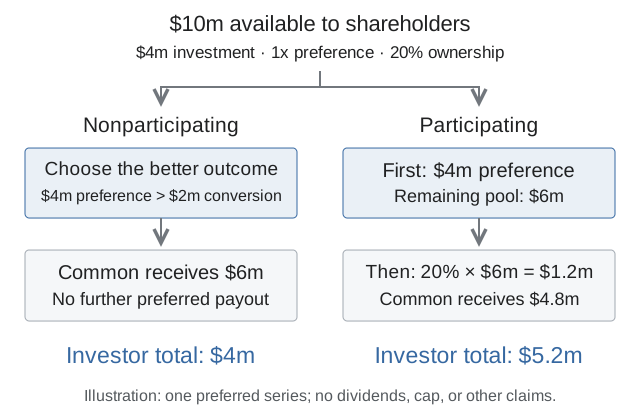
A company can negotiate a high valuation and still give away a large share of the proceeds at a later sale. To understand a financing, connect three questions: who receives money first, who shares in what remains, and when investors can turn their holdings into cash? Those questions link private-company investment terms to an initial public offering.
Review Startup funding, valuation, and investor rights first. Here, proceeds means money or other consideration available for distribution. A waterfall is the rule that allocates those proceeds in a specified order. The examples below use invented numbers to expose the mechanics; they do not reconstruct a case company's actual returns.
Read the preference before calculating the payoff #
Preferred stock gives its holders rights that differ from common stock. A liquidation preference specifies a preferred payment ahead of common shareholders when a defined event occurs. A 1x preference commonly means a preference equal to the original investment, subject to the actual terms. A sale or merger can count as a deemed liquidation event even if the business continues operating. NVCA's model charter provides alternative preference structures and defined transaction triggers, illustrating why the contract matters.[1]
Preference is an equity claim, not a guarantee that cash exists. Begin with the value available to shareholders after the relevant obligations and transaction costs. Debt generally ranks ahead of equity, but creditor priority depends on collateral, liens, subordination and applicable law. A lien is a claim against specified property securing an obligation. Two lenders may have claims on different assets, so one company-wide ranking can conceal important details.
Among preferred investors, seniority determines whose preference comes first. If two series rank pari passu, they share the same priority; an insufficient pool is allocated according to their agreed entitlements. Later investors can negotiate a senior position, but later financing does not automatically create that position. Existing terms, required approvals and amendments determine it.
Imagine $9 million is available to shareholders. Series B has a $6 million preference senior to Series A's $4 million preference. First pay B $6 million. The remaining $3 million goes to A, leaving A $1 million short and common shareholders nothing. If the two series instead share priority in proportion to their $6 million and $4 million entitlements, B receives 60 percent of $9 million, or $5.4 million; A receives $3.6 million. The same exit value produces different recoveries because the contracts differ.
Work through nonparticipating and participating preferred #
Conversion exchanges preferred shares for common shares using the agreed conversion ratio. An as-converted percentage is the ownership percentage calculated as if that conversion occurred. Nonparticipating preferred receives its preference or the common-equity outcome, whichever the terms permit and is better. Participating preferred receives its preference and then a share of the residual proceeds. Participation in an exit is different from a right to invest in a future round.[1]
Use one investor who invested $4 million for a 20 percent as-converted stake and a 1x preference. Assume one preferred series, no dividends, no participation cap, no additional creditors or costs, and $10 million available to shareholders.
- With nonparticipating preferred, the preference is $4 million. Conversion would produce 20 percent of $10 million, or $2 million. The investor takes $4 million; common holders receive $6 million.
- With participating preferred, pay the $4 million preference first. That leaves $6 million. The investor receives 20 percent of that residual, or $1.2 million, in addition to the preference. Total investor proceeds are $5.2 million; common holders receive $4.8 million.
- Check the total: $5.2 million plus $4.8 million equals the $10 million available. Applying 20 percent to the full proceeds after already paying the preference would incorrectly count part of the pool twice.
At a $40 million exit, nonparticipating preferred can convert for $8 million, which exceeds its $4 million preference. Uncapped participation instead produces $4 million plus 20 percent of the $36 million residual, totaling $11.2 million. The terms matter at both moderate and large exits.
A participation cap limits a defined payout, often using a multiple of investment. State whether the cap includes the preference, how residual money is allocated after reaching it, and whether conversion remains available. Saying only “2x cap” leaves essential mechanics unspecified. If the total preferred route is capped at $8 million but conversion is available, the investor may prefer conversion when its common-equity share exceeds $8 million. A cap need not cap every possible economic outcome.
Exchange today's valuation for tomorrow's distribution #
The Metapath case frames a negotiation between a higher entry price with participation and a lower entry price without it. Valuation is the value assigned to the business for the financing; dilution is the reduction in an existing holder's ownership percentage as additional shares are issued. A lower valuation can give the new investor more shares immediately. Removing participation changes the exit allocation later.
Consider two invented offers for the same $4 million investment. Offer A gives the investor 20 percent with uncapped 1x participation. Offer B gives it 25 percent with 1x nonparticipating preferred. At a $10 million exit, A pays the investor $5.2 million; B pays $4 million, because its 25 percent conversion outcome is only $2.5 million. At a $40 million exit, A pays $11.2 million; B pays $10 million through conversion. At a $100 million exit, A pays $23.2 million; B pays $25 million. Common holders prefer B in the first two scenarios and A in the third, under these assumptions.
The comparison explains why neither the higher valuation nor the absence of participation settles the decision. Evaluate the plausible exit values and timing, financing need, and shareholder interests. Add a proposed cap as a separate scenario with explicit rules. Do not quietly assume an IPO will erase the sale terms: any automatic conversion must meet the contract's conditions.[1]
A stock-for-stock merger adds another complication. Receiving shares in a combined company can satisfy an economic entitlement under the transaction terms without producing immediate cash. Relative ownership, the valuation assigned to the shares, resale restrictions and future business risk are separate questions. The Metapath discussion illustrates that mechanism; it does not establish a complete verified sequence of intervening financing values or investor returns.
Separate information, control and exit rights #
Rights often travel together in a financing, but they solve different problems. NVCA's document set separates the charter, investors' rights, voting and first-refusal/co-sale agreements. Each has its own role.[2]
Information rights specify which reports investors receive and when. A board seat adds participation in governance, but one seat does not necessarily control the board. Protective voting rights can require approval for particular major actions without granting control over every operating decision. A covenant similarly creates a contractual obligation: a positive covenant requires an action; a negative covenant restricts one.
Vesting makes an employee's equity entitlement depend on time or other conditions. If an employee leaves before vesting, the arrangement may preserve equity for a replacement. Acceleration changes that schedule following defined events; a valuable acquisition alone does not establish automatic full vesting.
Anti-dilution protection can adjust preferred conversion terms following a lower-priced financing, called a down round. Its formula, exclusions and any requirement to contribute new money determine its effect. That protection addresses a different issue from the ordinary decline in percentage ownership when more shares are issued.
A right of first refusal typically concerns a proposed transfer of existing shares: the right holder can match a qualifying third-party offer. A right to buy a share of a new issuance concerns new money and new shares. Distinguish those transactions before claiming a provision prevents dilution.
Redemption provides a contractual route for the company to repurchase shares under specified conditions. Cash availability and legal restrictions can limit performance. Demand registration rights allow eligible holders to request registration of securities subject to conditions; they are different from a demand for repayment or liquidation. Registration does not guarantee willing buyers or a particular selling price. Fund timing explains the interest in these rights, while the documents establish what can actually happen.[1][2]
A pooled-loan waterfall also allocates losses #
Securitization pools financial assets and issues claims on their cash flows. A tranche is one class of those claims with defined payment and loss priority. It is not simply a random handful of loans assigned to one investor. Mortgage-backed securities use mortgage exposures; other asset-backed securities can use loans or receivables such as auto loans. In a basic senior/subordinate structure, payments reach senior claims first and losses are absorbed by junior protection first.[3]
For an invented $100 million pool, suppose senior, middle and junior claims have balances of $80 million, $15 million and $5 million. A $3 million principal loss falls entirely on the junior claim. A $7 million loss exhausts its $5 million, then removes $2 million from the middle claim. The senior claim starts taking principal losses only when total losses exceed the $20 million beneath it, within this simplified structure. That threshold concerns loss amount, not the percentage of borrowers who default: recoveries can offset part of a defaulted loan's balance.
Diversification can reduce exposure to a local shock. It offers less protection when many borrowers share a common risk, such as a broad housing-price decline or a loss of refinancing access. Federal Reserve research examines how uncertainty and information problems in structured mortgage securities contributed to trading breakdown during the financial crisis.[4] Geographic variety alone does not establish independent risks, and one mechanism does not explain the entire crisis.
Higher promised yield on a junior claim compensates for greater exposure; it does not assure a higher realized return. A rating also describes an assessment under assumptions, rather than making the security immune to losses or illiquidity.
Recoverable value requires more than an appraisal #
A distressed-debt buyer acquires a claim and its associated rights. It does not necessarily acquire the collateral immediately. Restructuring changes obligations; enforcement, foreclosure or liquidation can realize rights against assets. A trustee or servicer may coordinate payments and enforcement for a group of investors.
Recovery analysis should distinguish the debt's face amount, the asset's estimated value and the amount obtainable after costs, delays and competing claims. A property estimated at $1 million that sells for $850,000 with $100,000 of assumed prior claims and costs leaves $750,000 for the remaining entitled claimants. That arithmetic is an illustration, not a statement of any jurisdiction's lien priority.
Holding and improving an asset can avoid an immediate distressed sale but requires cash, management and patience. Check taxes, liens, property condition and enforcement requirements. Liquidity measures the ability to transact on acceptable terms; an asset can retain economic usefulness while being difficult to sell today.
The same distinction matters when comparing a second loan against collateral with refinancing existing debt. Keeping a low-rate first loan and financing only the extra amount exposes a different balance to the new rate than replacing the entire borrowing. Interest-only or variable-rate terms alter payments and future risks; they do not remove the obligation to repay principal.
Fund commitments explain pressure for an exit #
A venture fund has investors as well as portfolio companies. A capital commitment promises funding under an agreement; a capital call requests some of that promised money. Uncalled commitments can be available for later deployment, but they are distinct from cash already sitting in the fund.[5]
For example, an investor committed to $10 million who has funded $3 million may still owe $7 million through future calls. The manager cannot treat that $7 million as an unconditional bank balance: the agreement, notice process and investor's ability to fund matter. A general partner's investment through the fund also differs from a separate personal trade ahead of a fund purchase, which can create a conflict between personal benefit and investor interests.
A company may prefer another private round while its existing funds prefer an exit that produces realizations. That is an incentive conflict, not proof that either side is irrational. Fund life, available commitments, realized gains and capacity to support the company all affect the decision. Borrowing abroad adds currency, transaction-cost and offering-law questions; a lower quoted interest rate alone does not prove cheaper overall financing.
JetBlue: distinguish raising capital from investors selling #
An initial public offering, or IPO, is a company's first public offering of its shares. Newly issued shares raise capital for the company. Sales by existing holders send proceeds to those holders. Listing can create a future exit route without every earlier investor selling at the offering.
JetBlue's 2002 prospectus described the severe effects of September 11 on travel demand and costs, together with its own recovery and growth plans.[6] Those facts help frame the decision: analyze the airline's funding need and operating risks alongside investors' interest in eventual liquidity. Do not infer that an IPO immediately pays out all its venture backers.
On April 11, 2002, JetBlue announced an offer of 5,866,667 shares at $27 per share, with all those shares offered by JetBlue.[7] Multiplication gives about $158.4 million of gross proceeds before underwriting discounts and other offering expenses. The IPO was therefore a capital raise for the issuer; gross proceeds were not identical to net cash retained.
Underwriting assigns distribution risk #
An underwriter helps structure and distribute securities. In a firm-commitment arrangement it agrees to buy securities on agreed terms and resell them. In a best-efforts arrangement it seeks buyers without committing to buy the entire issue itself. The underwriting contract establishes the obligations and closing conditions.[8]
Suppose an issuer offers one million new shares at $20 with a $1 underwriting discount per share. In a simplified firm commitment, the issuer receives $19 million before other expenses and the underwriters can receive $20 million from resale, leaving a $1 million gross spread before their costs. If they must resell below the intended price, that changes their economics; it does not simply create a matching refund of the agreed issuer proceeds. The example assumes the commitment closes as contracted.
In best efforts, failure to find enough buyers can leave the issuer short of its intended funding. Minimum-sale or all-or-none conditions can determine whether an offering closes at all. Compare those conditions before selecting a structure.
A syndicate is a group of firms coordinating distribution and underwriting. Lead managers organize work such as diligence, marketing, pricing and allocation; firms' purchase obligations need not be equal. A selling-group member can help sell without assuming the same purchase obligation. JetBlue's announcement identified Morgan Stanley as sole bookrunner, alongside other managers.[7] Its prospectus specified each underwriter's purchase share and required the underwriters to take all the base offering shares if any were taken, subject to its conditions.[6]
Choose a price with proceeds and trading in view #
Bookbuilding collects investors' indications of demand at proposed prices. Oversubscription means demand at a proposed price exceeds the number of shares available. It can provide room to select buyers, but indications can change and do not guarantee a liquid or rising aftermarket.
Consider an invented issue of one million shares. At $20, indicated demand is 1.6 million; at $24 it is 1.05 million. The higher price could raise $4 million more gross proceeds, but offers a smaller demand cushion. Evaluate the credibility and price sensitivity of the orders, the company's capital need, market conditions and the investor mix. Neither the highest price nor the largest first-day rise is a complete objective.
Underpricing compares the offer price with a subsequent trading price, often the first-day closing price. If a $20 issue closes at $25, the initial return is ($25 - $20) / $20 = 25 percent. Multiplying the $5 gap by one million offered shares gives $5 million as a simple proceeds-gap measure. It does not prove the issuer could have sold that entire issue at $25: the later price reflects a different moment and trading supply.
Public-market liquidity requires buyers and sellers. Long-term ownership can support stability, while some turnover enables trading. Allocating only to buyers assumed never to sell does not by itself create a functioning market, and encouraging immediate resale can create its own pressures.
A lockup contract restricts specified holders' sales for a period. IPO purchasers and earlier insiders are different groups. SEC guidance explains that insider lockups vary and their terms appear in offering documents.[9] JetBlue's historical prospectus distinguished freely tradable offering shares from earlier shares subject to lockups and other resale requirements.[6] A lockup expiry can increase potential supply; it does not force every holder to sell or establish a certain price fall.
Practice and explained answers #
1. An investor has a $3 million 1x participating preference and a 30 percent residual share. At a $12 million shareholder exit, what does it receive? Pay $3 million first, leaving $9 million. Thirty percent of that residual is $2.7 million, so total investor proceeds are $5.7 million. Common holders receive $6.3 million. The amounts sum to $12 million.
2. Under nonparticipating terms with the same preference and ownership, what changes? Compare $3 million with 30 percent of $12 million, or $3.6 million. The investor chooses the conversion outcome, receiving $3.6 million. It does not add a preference to that amount. Common holders receive $8.4 million.
3. Does a geographically diverse loan pool eliminate the need for junior protection? No. Loans can share a national economic or financing shock. Geographic diversification and contractual loss absorption address different risks, and neither establishes unlimited protection.
4. Does a successful IPO mean every existing investor has received cash? No. Determine who sold the shares. New issuer shares finance the company; an earlier holder realizes cash only through a sale or another distribution, with applicable restrictions. JetBlue's base 2002 offering was entirely issuer shares.[7]
5. What makes a financing recommendation explainable? State the objective and constraints, identify the preferred terms, calculate at least a weak and a strong outcome, and name the assumption most likely to change the choice. Research tools can test the reasoning, but the final explanation should be one you can defend without relying on their wording.
References
- a b c d NVCA: Model Certificate of Incorporation, October 2025, preference alternatives and conversion .
- a b NVCA: Model Legal Documents, financing and governance agreements .
- Federal Reserve: Report to the Congress on Risk Retention, securitization waterfalls .
- Federal Reserve research: Asymmetric Information and the Death of ABS CDOs .
- Federal Reserve: Private Credit Growth and Monetary Policy Transmission, uncalled commitments .
- a b c JetBlue: 2002 IPO prospectus, risks, underwriting and resale restrictions .
- a b c JetBlue: Initial Public Offering announcement, April 11, 2002 .
- Boustead Securities: 2018 audited report filed with the SEC, underwriting revenue recognition .
- SEC Investor.gov: Initial Public Offerings, Lockup Agreements .