
 The lecture encyclopedia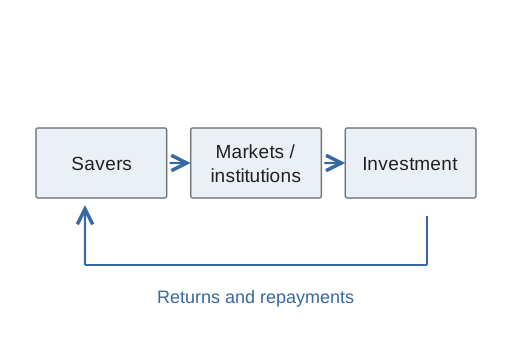
Financial markets develop mechanisms for pooling capital, transferring risk, exchanging information, and coordinating production. Each innovation changes incentives as well as opportunities. A structure that solves one problem can create another, especially when protection, leverage, or secrecy weakens competitive discipline.
Capital and competition #
Large trading enterprises required resources beyond what a single merchant could easily supply. Corporate organization enabled investors to pool funds and share exposure. State protection could help an enterprise establish itself, but a privileged position could also reduce incentives to improve.
High prices encourage competing supply, substitutes, and new technology. When a scarce product becomes widely available, scarcity profits fall. This process helps explain why early commercial dominance may not last.
Specialization presents a related choice. Owning every stage of production can improve coordination, yet it can also force a company into activities it performs poorly. The question is whether control creates more value than the cost of losing flexibility and expertise.
Institutions and confidence #
Broader access to incorporation lowers barriers to raising capital. Disclosure and oversight can help investors evaluate opportunities and limit abuse. Their design involves tradeoffs: useful information supports trust, while some commercial information has legitimate competitive value.
Confidence is itself economically important. A market that appears unfair may lose participants even if prices incorporate information rapidly. Market quality therefore involves more than the speed of price adjustment.
A financing system also needs sustainable underlying cash flow. Repeated borrowing or reinvestment among participants cannot permanently substitute for productive activity capable of supporting repayment.
Booms, debt, and productive assets #
An attractive opportunity draws investment, expands capacity, and may eventually produce overbuilding. Falling prices then make debt harder to service. Businesses can fail while their infrastructure remains useful to later owners.
Leverage magnifies exposure. A purchase funded with 20 units of equity and 80 units of debt gives the equity investor control of 100 units of assets, but debt payments remain due even when operating performance disappoints.
A yield spread is the difference between two yields. One hundred basis points equals one percentage point. A wider spread can compensate investors for greater risk or lower liquidity, though its interpretation depends on the instruments being compared.
Futures and options #
A futures contract creates obligations for both parties. It can help a producer and buyer reduce uncertainty about a future transaction. Speculators can accept risk that commercial participants seek to reduce.
An option instead gives its buyer a right. A call gives the right to buy at a strike price; a put gives the right to sell. The writer takes the corresponding obligation if assigned. The buyer pays a premium for that right.[1]
Payoff is different from profit. A put with a strike of 90 has an expiration payoff of 40 when the underlying asset is worth 50, but the premium must be subtracted when calculating the option's profit. Combining it with an owned asset changes the risk of the overall position.
Trading large positions #
Large orders can move prices or reveal information. Gradual execution, matched block trades, and venues with hidden pre-trade orders address these problems in different ways. None eliminates every trading cost.
Commission, spread, market impact, and information leakage are distinct. Understanding market innovation requires asking who receives a benefit, who bears the risk, and which incentive makes the arrangement function.