
 The lecture encyclopedia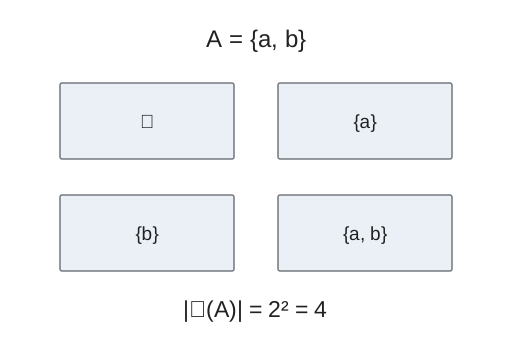
Set operations construct collections by testing membership. The distinction between an element and a subset is fundamental: membership asks about one object, while inclusion asks whether every element of one set also belongs to another.
Elements are not singleton sets #
Let A = {1, 2}. Then 1 ∈ A, but {1} ⊆ A. The set {1} is not itself an element of A. An element could be a set, but that would need to be explicitly represented, for example in B = {{1}, 2}.
The empty set is a subset of every set because it contains no element that could violate inclusion. A set is a subset of itself. A proper subset must additionally differ from the containing set.
Counting subsets #
Each element of a finite set can either be included or excluded from a subset. With n elements, there are 2ⁿ choices. For {a, b}, the subsets are ∅, {a}, {b}, and {a, b}. The collection of all subsets is the power set. Removing the full set leaves 2ⁿ - 1 proper subsets under the usual definition.[1]
Union and intersection #
A ∪ B contains elements in A or B, including those in both. A ∩ B contains only elements in both. For A = {1, 2, 3} and B = {3, 4}, the union is {1, 2, 3, 4} and the intersection is {3}. Duplicate appearances do not produce duplicate set elements.
Complement and universe #
A complement contains elements in the stated universe that are not in the set. If U = {1, 2, 3, 4, 5}, the complement of A above is {4, 5}. Changing the universe can change the complement without changing A itself. A complement expression without an understood universe is incomplete.
Equivalent size versus equal contents #
Two finite sets are equivalent in size when they have the same cardinality. Equality requires the same elements. Keeping those claims separate prevents a common mistake: two three-element collections need not be the same set, even though they have the same number of subsets.