
 The lecture encyclopedia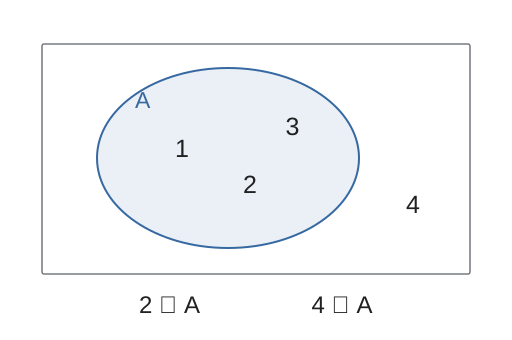
A set is a collection of distinct objects considered as a whole. The objects are its elements. Set notation provides a precise language for describing collections, comparing them, and forming new collections from existing ones.
Listing and describing elements #
Roster notation lists elements inside braces, such as {2, 4, 6}. Order and repetition do not change the set: {6, 2, 4, 2} describes the same collection. Set-builder notation states a property, such as {x ∈ ℤ : 0 < x < 4}, which describes the integers 1, 2, and 3.
The domain matters. The same inequality over real numbers describes infinitely many values rather than three integers. A description should establish which objects are eligible before applying the condition.
Membership and equality #
x ∈ A says that the object x is an element of set A; x ∉ A says it is not. Two sets are equal when they contain exactly the same elements. Finite sets have a cardinality, written |A|, equal to the number of distinct elements.
An empty set, written ∅ or {}, has zero elements. {∅} is different: it contains one element, which happens to be the empty set. The braces create a collection and therefore change the object being discussed.[1]
Finite and infinite collections #
A finite set can have its elements counted to a finite total. An infinite set cannot. The integers and real numbers provide familiar infinite domains, while a small roster gives a finite example. Ellipses in a roster indicate a continuing pattern but are useful only when that pattern is unambiguous.
Subsets and diagrams #
A ⊆ B means every element of A is also in B. It permits equality. A proper subset is a subset that is not equal to the containing set. A Venn diagram depicts relationships between sets, but the positions and sizes of drawn circles do not by themselves establish numerical proportions.
Reading a statement precisely #
Before deciding whether a statement is true, identify whether it compares an element with a set, two sets, or their sizes. {1, 2} and {3, 4} have equal cardinality without being equal sets. Precision at this level supports later counting and proof.