
 The lecture encyclopedia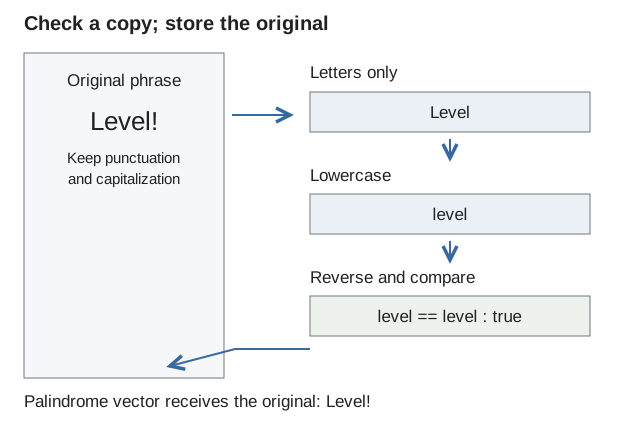
A palindrome reads the same forward and backward. For this lab's text rule, spaces, punctuation, and capitalization are ignored, and only letters take part in the comparison. The important programming idea is a sequence of small functions: each transforms or checks one piece of data, while the original phrase remains available for display.
The lab notes date this session October 6; the transcript header reads September 29. The article follows the lab notes’ date.
This lab combines C++ strings with vectors. The examples explain the stages and testing choices. Keep the required starter interfaces when applying these ideas to a program.
Define the comparison before writing the loop #
Normalization means changing data into a consistent form for a particular comparison. Here it has two parts: retain letters, then use one letter case. It does not mean changing what the user will eventually see.
Consider the supplementary phrase "Step on no pets!". Removing spaces and punctuation gives "Steponnopets". Converting to lowercase gives "steponnopets". Its reverse is also "steponnopets", so the normalized strings match.
Now consider "Blue bird!". Its letters produce "Bluebird", then "bluebird". The reverse is "dribeulb". These differ, so the phrase fails the palindrome comparison.
Using uppercase throughout would produce the same decisions for these ordinary English-letter examples. Consistency is what matters. Comparing a lowercase original with an uppercase reverse would introduce a difference unrelated to the text's letter order.
Give each helper one clear contract #
A contract states the helper's inputs, result, and permitted effects. The letter-filtering helper receives a string and returns another string containing only the retained letters in their original order. The lowercase helper returns a consistently cased version. The reversal helper returns the input characters in backward order. None needs to overwrite the user's original phrase.
The checker calls those processing helpers and returns a Boolean: true for a match and false for a mismatch. Its result is a classification, not a printed message and not a replacement phrase. The calling input loop decides where to store the original.
Passing strings by value fits this copy-based exercise. Each function receives its own string value. If a different interface uses a const reference, the contract should still promise that the input will be read without modification. Interface choices and behavior should agree.
Test a helper separately before combining them. If the final answer is wrong, inspect the output of filtering, casing, and reversal in that order. A punctuation character left behind is a filtering problem; a lost lowercase conversion is a casing problem. Separating the stages makes those causes visible.
Character tests and conversions return values #
std::isalpha tests whether a character is alphabetic; a nonzero result means it passed. It is the appropriate predicate for a letters-only rule. std::isalnum would also retain digits, changing the rule. These character classifications depend on the character environment and locale. The examples here use ordinary English letters.[1]
The standard <cctype> functions require an argument representable as unsigned char, or the special EOF value. A plain char can be signed, so convert a character read from a string to unsigned char before classifying or converting it. This avoids passing a negative char value outside the accepted range.[1]
std::tolower returns a converted value. Calling it and discarding its result does not update the original character. Store its result in a character or append it to the output being built. Characters that have no lowercase conversion remain unchanged.[2]
char original = 'G';
unsigned char safe = static_cast<unsigned char>(original);
char lower = static_cast<char>(std::tolower(safe));
// original is still 'G'; lower is 'g'.
This short illustration uses <cctype>. The first cast establishes a valid input value for conversion; the second converts the function's integer result to a char for storage. Keep the distinction between a test, which answers a question, and a conversion, which supplies a value.
Trace reversal without an invalid index #
For the normalized string "lamp", valid indexes are zero through three. A reversed result reads characters at indexes three, two, one, and zero, producing "pmal".
A useful backward traversal starts with a count of unprocessed characters. If that count is four, read index three and reduce the count to three. Next read index two, then one, then zero. Stop when the count is zero. The accessed index is always one less than a positive count.
This reasoning also handles an empty string: its count starts at zero, so the loop never attempts a character access. Avoid blindly initializing an unsigned index with text.size() - 1. For empty text, subtracting one from unsigned zero wraps to a large value. A count-based loop avoids needing a negative stopping index.
After reversal, compare two strings in the same normalized form. Equality does not decide to ignore punctuation or case on its own. The earlier stages are what make those differences irrelevant.
Read a whole phrase and recognize the stop signal #
A sentinel is input that controls the loop instead of becoming ordinary data. In this lab, the stop word is quit under the starter's stated matching rule.
Use std::getline to read a complete line. Formatted extraction into a string with >> stops at whitespace, which would split a multiword phrase. The usual getline overload reads up to the newline, consumes that delimiter, and leaves it out of the stored string.[3]
Process each successful line in this order: check whether it is the sentinel, classify it if it is ordinary input, and store its original text in the appropriate list. A sentinel must be recognized before it reaches the checker or the result lists. Input ending without a sentinel should also allow the loop to finish cleanly.
Do not silently broaden the stop rule. If the starter specifies exactly "quit", that is different from automatically treating "QUIT" or "quit!" as commands. The normalization rule for palindrome checking does not necessarily apply to command recognition.
If earlier input used formatted extraction, remember that a leftover newline can make the next getline return an empty line immediately. Either keep this phrase-reading workflow consistently line-based or deliberately handle the transition from formatted input.
Preserve originals in two vectors #
A vector is a growing sequence of elements. Here each element is a string containing one original phrase. One vector holds successful palindrome inputs and another holds unsuccessful inputs.
Suppose the user enters "Level!", "Blue bird!", and then quit. The checker sees "level" and "bluebird", but the vectors store "Level!" and "Blue bird!". The first original goes into the palindrome vector and the second into the other vector. The sentinel goes into neither.
Use push_back to add an element to the end of the chosen vector. A helper that prints a vector can visit its existing strings and output a tab before each phrase. A tab is an output character, not a feature of vector storage. Main can print a label and call the helper once per list.
Keep classification, storage, and display separate. Replacing the stored phrase with a cleaned version would lose the capitalization and punctuation the user entered. Printing each answer immediately would also differ from collecting and displaying the two groups at the end.
Choose tests that reveal different mistakes #
Begin with a lowercase palindrome such as "level" and a nonpalindrome such as "lamp". Then add "LeVeL" to check casing and "Step on no pets!" to check spaces and punctuation together. Verify both the Boolean decision and the original text retained in the appropriate vector.
Test a single letter, repeated inputs, and an empty result list. Enter the sentinel as the first line: both lists should remain empty, and the sentinel should never appear beneath either label. Check end-of-input as well as the explicit stop word.
A phrase with no retained letters exposes a policy question. Both its normalized form and its reverse are empty, so the literal equality algorithm returns true. The available lab explanation does not establish a separate rule for this case. Check the starter's requirements before adding a rejection rule or presenting that result as the intended policy.
Practice with explained answers #
What happens to "A1b" under the letters-only rule? It becomes "ab". Its reverse is "ba", so it is not a palindrome. Using isalnum instead would retain the digit and test a different normalized input.
Why does a standalone call to tolower fail to change an uppercase character? The function returns a value; it does not receive a reference to the original character. Assign or append the returned value to keep the conversion.
Which string belongs in the result vector for "Level!"? The original "Level!". The cleaned string is temporary comparison data, while the list records what the user actually entered.
Why must the sentinel check come first? A stop instruction is not a phrase to classify. Letting it pass into the checker would add an unwanted result and change the meaning of the input loop.