
 The lecture encyclopedia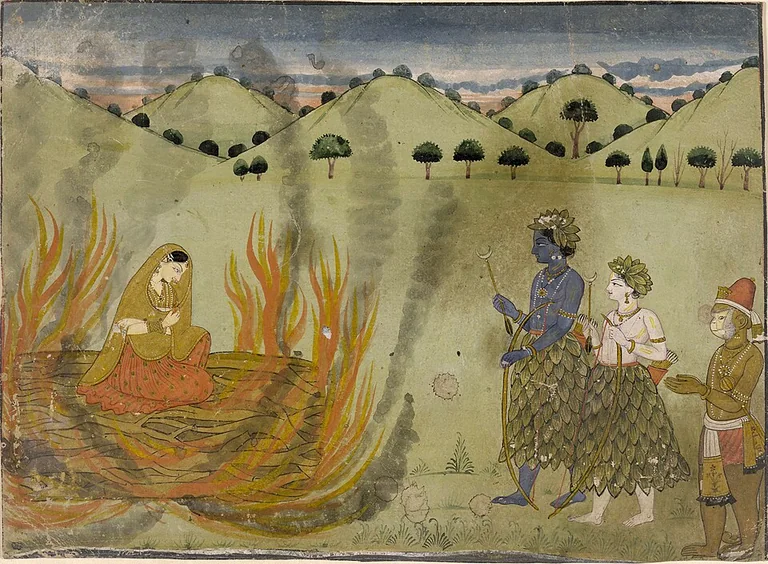

Sita's actions in the Ramayana expose the difficulty of reducing responsibility to obedience. As a spouse, captive, and publicly judged figure, she encounters expectations concerning loyalty, purity, honor, and self-respect. Close reading shows how the narrative can invoke these expectations while also making their consequences painful and morally unsettling.
Marriage and interpretation #
When Sita insists on accompanying Rama into the forest, the meaning of marital duty becomes contested. One interpretation treats a husband's instruction as decisive. Another understands shared life and loyalty as requiring participation in hardship rather than remaining safely behind.
The disagreement is therefore not simply between duty and desire. Both sides can claim to identify what responsibility requires. Sita's speech matters because it shows her interpreting the obligations of marriage rather than merely receiving them.
The scene also challenges assumptions about passivity. A character can use the language of an inherited social system to contest another person's interpretation of that system. Agency and constraint can exist together.
The public reunion #
After the conflict with Ravana, reunion does not resolve every tension. Rama's treatment of Sita brings public honor and private loyalty into direct confrontation. Accusation before an audience magnifies the injury by making reputation part of the scene itself.
The reader must distinguish several questions: what happened to Sita, what Rama believes, what others suspect, and what he thinks his public role demands. Conflating those questions makes the moral conflict appear simpler than the narrative presents it.
Literary details shape judgment. Emotional speech, comparisons, silence, and the reactions of other characters can undermine the apparent confidence of a declaration about duty.
The fire ordeal #
Sita's entry into fire appears in a context of rejection and public accusation. The scene can be read as a demand for vindication, an expression of anguish, or an action forced by intolerable social conditions. These readings need not assign identical motives or emotional states to her.
Agni's vindication connects the epic to the earlier significance of fire as a divine mediator. Yet proving innocence does not automatically settle whether demanding such proof was just.[1]
Rama's subsequent explanation raises a further question: if he already trusted Sita, can public demonstration justify the suffering imposed on her? The distinction between a claimed purpose and the means used to achieve it is central.
This literary ordeal is not a model for real-world action. Its ethical significance lies in examining coercion, reputation, loyalty, and the burdens placed on the person whose innocence is challenged.
Versions and emotional framing #
A performance can make the ordeal appear confident and reassuring, or painful and uncertain. The same basic event takes on a different meaning when actors, music, narration, or visual composition change the audience's understanding of what the characters know.
Comparing versions therefore involves more than checking whether the plot matches. It requires attention to emotional framing and the distribution of sympathy.
Evaluating responsibility #
An interpretation should identify a concrete action and explain the obligation it fulfills or violates. Sita's loyalty, Rama's public role, and the community's expectations cannot be evaluated adequately through labels alone.
The narrative invites moral discomfort because responsibility itself can become contested. A claim to defend order may harm someone who has fulfilled her duties, leaving readers to ask what a defensible account of order must include.