
 The lecture encyclopedia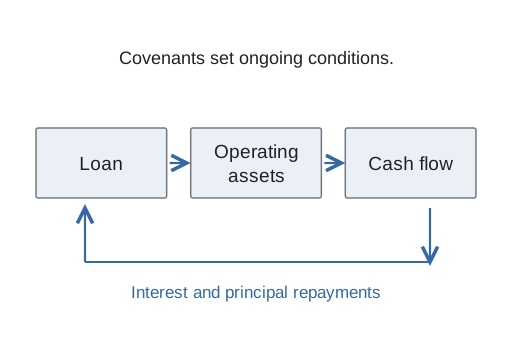
Bank credit analysis evaluates whether a proposed loan can be repaid from the borrower's operations and how losses might be limited if repayment fails.
Define the financing request #
Credit analysis begins with the amount, purpose, timing, and uses of funds. A business may need money for equipment, construction, working capital, or entry into a new market. These uses create different repayment patterns and different risks.
The analyst also needs total project cost, existing obligations, and the proposed contribution from equity investors. A loan that appears sufficient under the central forecast may become inadequate if the project is delayed or costs rise.
Separating established demand from expected future demand is essential. Expanding production of a proven product is not equivalent to assuming customers will buy a new product in an unfamiliar market.
Identify the repayment source #
The primary question is how operations generate cash available for debt service. Revenue alone is insufficient. Operating costs, working-capital needs, other debt payments, and required investment can consume cash before a lender is paid.[1]
A downside scenario tests what happens when sales disappoint, construction takes longer, or margins narrow. It should connect assumptions to cash rather than merely call the business risky.
Collateral provides a possible secondary recovery source. Recoverable value depends on saleability, prior claims, and the circumstances of enforcement. An asset's accounting value may be a poor estimate of what a lender could realize during distress.[2]
Funding dependencies #
A plan combining bank debt with new equity contains a sequencing problem. If the equity does not arrive, the bank may be left financing a project with too little loss-absorbing capital.
A condition requiring the equity investment to close before a loan draw addresses this dependency. Milestones and permitted uses of proceeds can provide additional control over how funds are deployed.
Such conditions should be specific enough to verify. A general expression of confidence in future fundraising does not establish that the resources will be available when needed.
Covenant design #
A covenant is a contractual requirement intended to protect the lending relationship. Restrictions on distributions or additional borrowing can preserve cash and limit new competing claims. Financial tests and reporting obligations can provide warning of deteriorating performance.
Each covenant should answer four questions: which risk it addresses, how compliance is measured, when measurement occurs, and what follows a breach. A vague restriction can create disagreement without providing useful protection.
Not all protections do the same job. Collateral supports recovery, reporting provides information, and a funding condition prevents a particular transaction from occurring before prerequisites are satisfied.
Negotiation and decision #
The decision may be approval, rejection, or approval subject to conditions. A reasoned conclusion identifies the strongest supporting evidence and the most important unresolved concern.
Negotiation requires distinguishing essential protections from terms that can be exchanged for another concession. Enforcement must also be realistic. Accelerating repayment can force distress and reduce recovery, so a contractual remedy is not automatically the best economic action in every circumstance.
The final judgment should rest on a coherent repayment case.